
Key Takeaways
- Probiotics vs prebiotics: Probiotics are live microorganisms that add beneficial bacteria to your gut. Prebiotics are indigestible fibers that feed the bacteria already living there. You need both for optimal gut health.
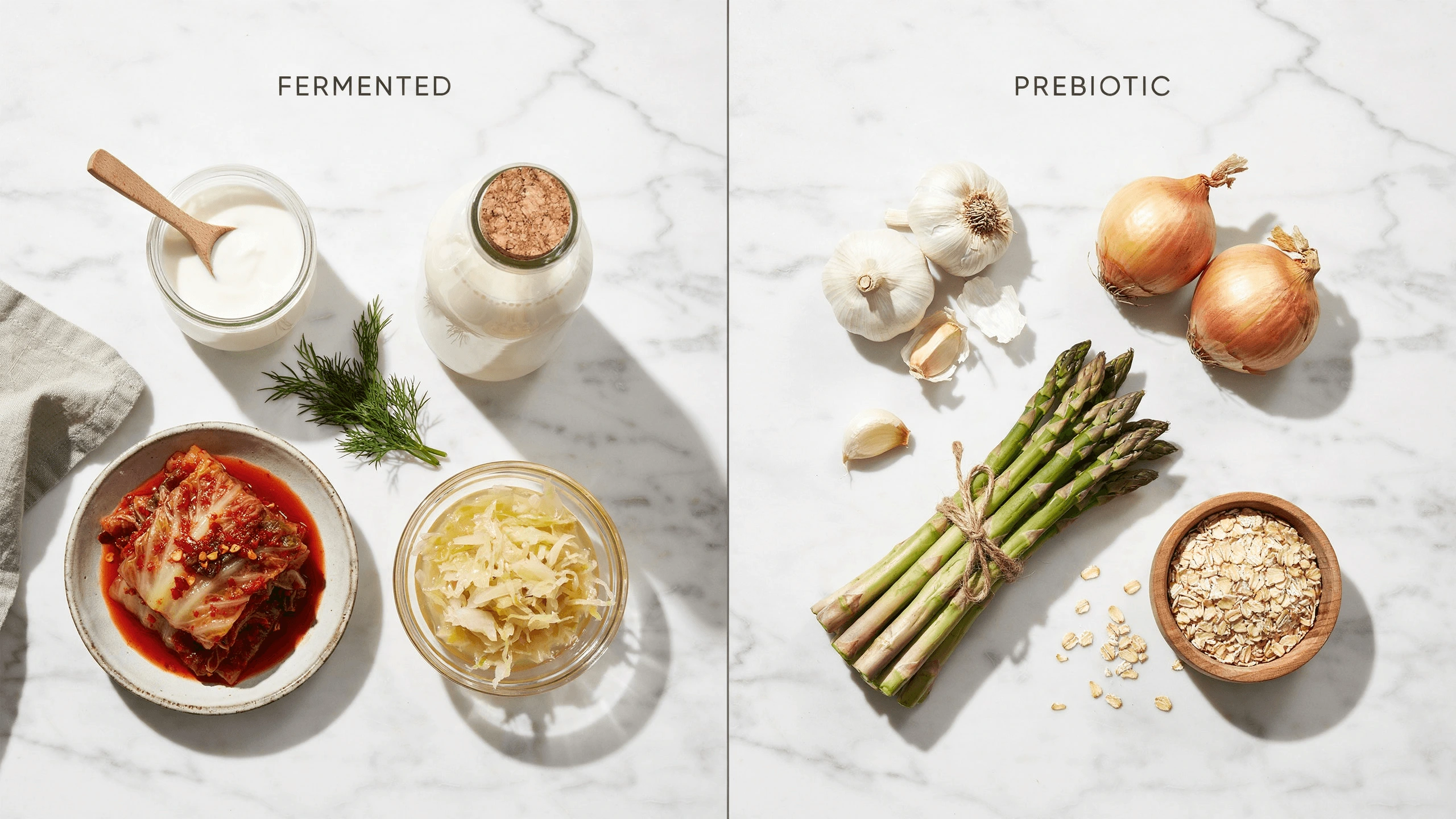
- The best food sources: Probiotics are found in fermented foods like yogurt, kefir, and kimchi. Prebiotics are found in fiber-rich foods like garlic, onions, and oats.
- Supplements: Most healthy people can support gut health through diet alone. Probiotic supplements are most useful after antibiotics or for specific conditions.
- The one thing to do: Add one fermented food and one prebiotic food to your meals today. Your gut will thank you.
The Confusion Ends Here
Probiotics vs prebiotics is one of the most Googled questions in gut health — and for good reason. The two terms sound almost identical, yet they do completely different things. One adds soldiers to your gut army. The other feeds the soldiers already stationed there.
Confusing them is easy. But understanding the difference is essential if you want to improve your digestion, immunity, and overall well-being.
This article will break down the probiotics vs prebiotics debate in plain English. You’ll learn what each one does, where to find them, how much you need, and why taking one without the other is like buying a plant but forgetting to water it.
If you’re new to gut health, start with our complete guide: How to Improve Your Gut Health Naturally.
What Are Probiotics?
Probiotics are live microorganisms — bacteria and yeast — that provide health benefits when consumed in adequate amounts.
According to the International Scientific Association for Probiotics and Prebiotics (ISAPP), a probiotic is “a live microorganism that, when administered in adequate amounts, confers a health benefit”.
Think of probiotics as reinforcements. They travel through your digestive system and help maintain a healthy balance of gut bacteria. They can:
- Fight harmful bacteria
- Strengthen the lining of your gut
- Support your immune system
- Produce neurotransmitters that communicate with your brain
“Probiotics are living organisms that keep a gut microbiome — an ecosystem of trillions of bacteria — balanced,” explains Elizabeth Eisnor, RD, a registered dietitian at the University of Rochester Medicine.
Best Food Sources of Probiotics
- Yogurt — Look for “live and active cultures” on the label
- Kefir — A fermented drink with more diverse probiotics than yogurt
- Kimchi — Fermented cabbage rich in Lactobacillus
- Sauerkraut — Choose unpasteurized for live cultures
- Miso — Fermented soybean paste
- Tempeh — Fermented soybean product
For a deeper dive into fermented foods, see our article on Fermented Foods for Gut Health.
What Are Prebiotics?
Prebiotics are indigestible dietary fibers that feed the beneficial bacteria already living in your gut.
“A prebiotic is a substrate that is selectively utilized by host microorganisms, conferring a health benefit on the host,” according to ISAPP.
Think of prebiotics as fertilizer. They don’t add new bacteria; they nourish the ones you already have. This is crucial because your gut already contains about 100 trillion bacteria. Probiotics add a few billion more — a drop in the ocean compared to what’s already there.
Prebiotics promote the growth of beneficial bacteria like Bifidobacterium and Lactobacillus, while also increasing the production of short-chain fatty acids (SCFAs), which are essential for gut and metabolic regulation.
Best Food Sources of Prebiotics
- Garlic — One of the richest sources of inulin
- Onions — High in prebiotic fibers
- Leeks — Good source of inulin
- Asparagus — High in inulin
- Jerusalem artichokes — Exceptionally rich in prebiotics
- Oats — Contains beta-glucan
- Apples — Rich in pectin
- Slightly under-ripe bananas — Resistant starch
For a full prebiotic meal plan, see our 7-Day Prebiotic Meal Plan.
Probiotics vs Prebiotics: The 5 Key Differences
| Feature | Probiotics | Prebiotics |
|---|---|---|
| What they are | Live microorganisms | Indigestible fibers |
| What they do | Add beneficial bacteria | Feed existing bacteria |
| Best food sources | Fermented foods | Fiber-rich plant foods |
| Supplement form | Capsules, powders, liquids | Powders, capsules, gummies |
| Main benefit | Restore and balance gut flora | Nourish and grow good bacteria |
Why You Need Both Probiotics vs Prebiotics (And Why One Without the Other Fails)
Taking probiotics without prebiotics is like planting seeds in barren soil. The bacteria arrive, but they have nothing to eat. Many simply die off, and the benefits are temporary at best.
Research supports this. A 2025 review found that “probiotics alone often fail” without fermentable substrates to support them. Prebiotics, on the other hand, consistently increased beneficial bacteria and short-chain fatty acid production.
The solution? Combine them. When probiotics and prebiotics are taken together, they form synbiotics — synergistic formulations that enhance microbial stability and therapeutic efficacy.
Practical tip: Eat a fermented food (probiotic) alongside a fiber-rich food (prebiotic). For example, yogurt with sliced banana, or kimchi with brown rice.
The Third Player: Postbiotics
Postbiotics are the metabolites produced when probiotics ferment prebiotics. They include short-chain fatty acids, peptides, and other bioactive compounds.
Think of it this way: Probiotics are the workers. Prebiotics are the food. Postbiotics are the products they create.
Emerging research shows that postbiotics may support immune function, improve intestinal barrier integrity, and even influence mental health through the gut-brain axis. They are also more stable than probiotics, making them a promising alternative for certain applications.
You don’t need to supplement with postbiotics. If you feed your gut well, your bacteria will produce them naturally.
Do You Need Supplements?
For most healthy people, no. A balanced diet rich in fermented foods and fiber provides what you need.
However, supplements can be helpful in specific situations:
- After antibiotics — to restore beneficial bacteria
- For IBS or digestive conditions — specific strains may help
- During travel — to support your gut when routines change
The American Gastroenterological Association found limited evidence for probiotics in most digestive issues, with exceptions for preventing C. difficile after antibiotics and managing pouchitis.
If you do take a probiotic supplement, choose one with specific strains backed by research, such as Lactobacillus rhamnosus GG or Saccharomyces boulardii.
FAQ: Your Probiotics and Prebiotics Questions Answered
Can I take probiotics and prebiotics together?
Yes. In fact, they work better together. This combination is called a synbiotic.
What is the best time to take probiotics?
Most probiotics are best taken 30 minutes before a meal or with food. Follow the instructions on your specific product.
How long does it take for probiotics to work?
Some people notice improvements in digestion within days. For longer-term benefits, take them consistently for 2–4 weeks.
Are prebiotics better than probiotics?
Neither is “better.” They serve different purposes. Prebiotics may have more consistent effects on the microbiome, while probiotics can be helpful for targeted support.
Can probiotics cause bloating?
Yes, some people experience temporary bloating or gas when starting probiotics. This usually subsides as your gut adjusts.
Do prebiotic sodas work?
Prebiotic sodas contain fibers like inulin, which can support gut health. However, they shouldn’t replace whole-food sources of fiber.
What foods are both probiotic and prebiotic?
Some fermented foods contain both. For example, kimchi and sauerkraut contain live bacteria (probiotics) and fiber from the cabbage (prebiotics).
Should I take probiotics every day for probiotics vs prebiotics balance?
If you’re taking them for a specific condition, consistency is key. For general gut health, dietary sources are usually sufficient to maintain a healthy balance between probiotics vs prebiotics.
The One Thing to Do Today
Understanding probiotics vs prebiotics starts with one simple action: add one fermented food and one prebiotic food to your meals today.
Try yogurt with sliced banana for breakfast. Add garlic and onions to your dinner. Kimchi with brown rice. Small changes, big impact.
For recipe ideas that combine both, explore our Gut-Health Recipes.
Enjoyed This Article?
Follow us on Facebook and Instagram for more science-backed gut health tips, recipes, and wellness strategies.
👉 Follow us on Facebook: https://www.facebook.com/profile.php?id=61566783953565
👉 Follow us on Instagram: https://www.instagram.com/healthywellrecipes
References
- ScienceDirect. (2026). Advances in probiotic–prebiotic science: mechanisms, clinical applications, and emerging microbial therapeutics. https://www.sciencedirect.com/science/chapter/edited-volume/abs/pii/B978044340483200042X
- University of Rochester Medicine. (2026). Prebiotics vs. Probiotics: What’s the Difference and Do You Need Both? https://www.urmc.rochester.edu/news/publications/health-matters/prebiotics-vs-probiotics-whats-the-difference-and-do-you-need-both
- Pharmacy Times. (2026). The Expanding Power of Probiotics and Prebiotics in Overall Health. https://www.pharmacytimes.com/view/the-expanding-power-of-probiotics-and-prebiotics-in-overall-health
- World Gastroenterology Organisation. (2026). Why Probiotics Alone Are Insufficient for Sustained Gut Microbiota Modulation. https://www.worldgastroenterology.org
- Cedars-Sinai. (2025). Should You Take Probiotics and Prebiotics? https://www.cedars-sinai.org/stories-and-insights/expert-advice/should-you-take-probiotics-and-prebiotics
- ScienceDirect. (2026). Targeting the human gut microbiome: a comparative review of probiotics, prebiotics, synbiotics, and postbiotics. https://www.sciencedirect.com/science/article/pii/S2090123225010227
- GutCited. (2026). Probiotic Strains and Clinical Evidence: What the Research Really Shows. https://gutcited.com
Disclaimer: This article is for informational purposes only and does not replace professional medical advice. Consult your doctor or a gastroenterologist if you have persistent digestive symptoms.