
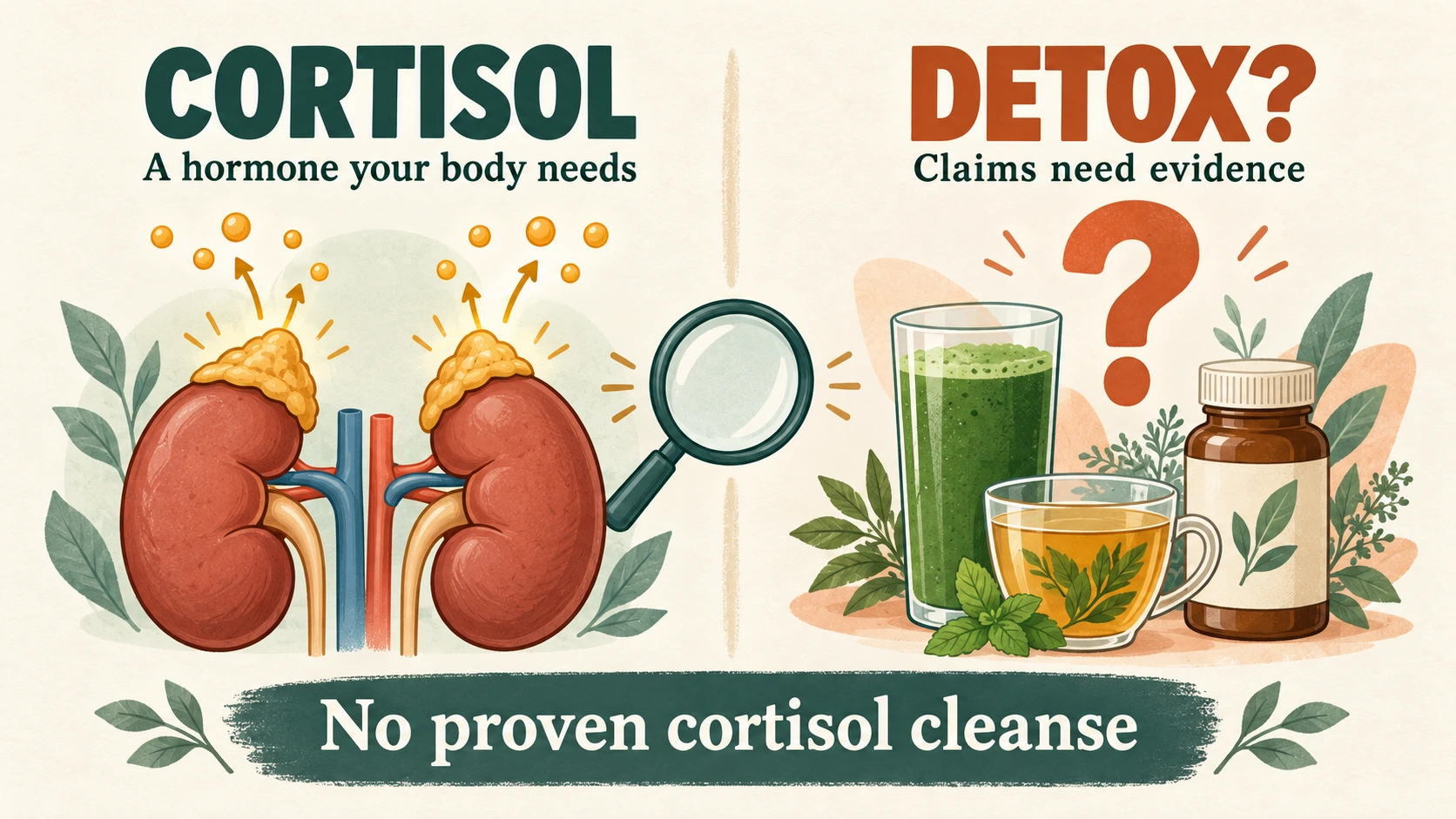
Cortisol detox advice can make a stressful week sound like a hormone emergency. A restless night, afternoon tiredness or a change in your appearance suddenly becomes a reason to buy a powder, follow a cleanse or order a test.
Those concerns deserve attention. But they do not automatically mean cortisol is the cause—or that your body needs help removing it.
Before adding another wellness routine to your day, here are five facts to help you evaluate the promises.
This article provides general education, not medical advice or a personal hormone treatment plan.
What Is a Cortisol Detox?
The phrase usually describes habits or products promoted as ways to lower cortisol. Depending on the source, that might mean supplements, special drinks, restrictive diets or morning routines.
There is no standard program behind the name. Two sellers offering a cortisol detox may recommend completely different things.
The label itself does not establish that an approach works. The useful questions are what was studied, who participated and whether the findings support the advertised result.
1. Cortisol Is a Hormone Your Body Needs
Cortisol often gets cast as the villain in wellness content. Its actual role is more complicated.
Your adrenal glands produce cortisol, which helps regulate metabolism, blood pressure and the response to stress. Its levels also change throughout the day.
The Endocrine Society overview of adrenal hormones explains these functions.
A changing cortisol level is not automatically a problem. The goal is not to remove the hormone or push it as low as possible.
Medical conditions involving too much or too little cortisol require appropriate assessment and treatment. A cleanse is not a substitute.
For more background, read our Chronic Stress and Adrenal Health guide.
2. Common Symptoms Cannot Diagnose High Cortisol
Tiredness, poor sleep and weight changes can have many explanations. An online checklist cannot determine whether the cause involves stress, medication, a sleep disorder or another condition.
The same applies to appearance. Facial fullness or abdominal weight alone cannot identify a cortisol disorder.
How Is Cushing’s Syndrome Different?
Cushing’s syndrome involves prolonged exposure to excess cortisol. It is different from simply having a demanding schedule.
A clinician may investigate a combination of findings, including easy bruising, wide purple stretch marks, muscle weakness and other progressive changes.
These findings still need interpretation. Diagnosis involves medical history, examination and appropriate testing.
The NIDDK guide to Cushing’s syndrome explains the condition and how clinicians investigate it.
Should You Order a Cortisol Test?
Start with the concern you want to understand.
Cortisol tests have legitimate medical uses, but timing, medications and the sample type affect interpretation. Tests used to investigate a particular disorder are not interchangeable with a general “stress score.”
Ask a clinician:
- Would testing help explain my symptoms?
- Which test would answer that question?
- Could my medication affect the result?
- What would happen after an abnormal result?
A test is most useful when there is a clear plan for interpreting it.
3. Cortisol Detox Drinks Do Not Establish a Treatment
A drink can taste good without changing your hormones.
Juice, coconut water, salt and herbal ingredients do not become a treatment for excess cortisol simply because someone combines them in a recipe.
Before trying a product, examine the promise.
| Promotional claim | Question worth asking |
|---|---|
| “Flushes excess cortisol” | What evidence shows that the finished product does this? |
| “Balances hormones naturally” | Which hormone and which diagnosed condition? |
| “Works in seven days” | Does the research support that timetable? |
| “Clinically tested ingredients” | Did researchers test this product or a different preparation? |
| “No side effects” | What safety and interaction information supports that claim? |
The NCCIH overview of detoxes and cleanses discusses the limited evidence behind detox programs and concerns about some products.
Be especially cautious when a program requires fasting, laxatives or replacing regular meals with drinks.
You do not need a cortisol detox menu to prepare balanced meals. Our Nourish to Flourish nutrition guide offers practical starting points.
4. Supplements Are Not Automatic Stress Solutions
A supplement bundle may combine several ingredients. That makes it harder to identify which ingredient caused a benefit, an unwanted effect or an interaction.
Ashwagandha is one example. Some preparations have been studied for stress and sleep, but those findings do not establish every product as a suitable cortisol treatment.
Reported concerns include liver injury, effects on thyroid function and medication interactions. The NCCIH overview of ashwagandha explains these precautions.
Magnesium and vitamin products also need a reason for use. A nutrient’s normal function does not prove that taking extra amounts resolves stress.
Before Buying a Cortisol Detox Supplement
Check:
- Every ingredient and its amount.
- Whether another product you use contains the same ingredient.
- Possible medication interactions.
- Whether the preparation matches the research.
- Whether the claim concerns symptoms, a laboratory measurement or a clinical outcome.
A change in a study’s cortisol measurement does not automatically prove that participants experienced meaningful relief.
Our Supplement Guides discuss evidence and safety without prescribing a personal routine.
Do not stop or reduce prescribed steroid medication to lower cortisol. Changes may require a supervised plan.
5. Practical Support Does Not Require a Cortisol Detox
You can address a difficult week without diagnosing a hormone problem first.
Start with what is getting in the way. Is it interrupted sleep, missed meals, too many responsibilities or ongoing emotional distress?
| Current concern | A manageable next step |
|---|---|
| Evenings feel rushed. | Choose one short wind-down activity. |
| Cooking feels overwhelming. | Keep ingredients for one familiar meal available. |
| Notifications interrupt every break. | Silence them briefly when circumstances allow. |
| Responsibilities feel unmanageable. | Ask for help or clarify one deadline. |
| Symptoms keep returning. | Arrange a healthcare appointment. |
These are ways to support daily functioning. They do not promise a measurable reduction in cortisol.
Give Sleep Some Attention
A manageable schedule and comfortable bedroom can be useful starting points. You do not need a complicated routine or a special drink.
Persistent sleep difficulties deserve assessment rather than repeated purchases.
Our How to Improve Sleep Naturally guide discusses everyday habits and when they may be insufficient.
Keep Movement Flexible
Choose activity that fits your health and current capacity. Walking, gardening, dancing or suitable strength exercises may be options.
A temporary exercise-related cortisol change does not, by itself, establish that an activity harms your hormones.
Avoid abandoning movement you enjoy solely because a wellness post calls it “cortisol-spiking.”
Address the Source of Pressure
A breathing exercise cannot remove financial strain, an unsafe situation or an impossible workload.
Practical help, counseling and changes to your circumstances may matter alongside personal habits. Needing support does not mean you failed at stress management.
When to Seek Medical Advice
Arrange an appointment when symptoms persist, worsen or interfere with daily life.
Bring notes about:
- When the symptoms began.
- Changes in sleep, appetite or weight.
- How your daily functioning has changed.
- Medications, including steroid medicines.
- Supplements and wellness products you use.
Describe what you have noticed rather than assuming a cortisol detox checklist has identified the cause.
This leaves room to investigate other explanations and choose appropriate care.
Frequently Asked Questions
Does a cortisol detox work?
There is no established cortisol detox program that should replace medical assessment or treatment. Evaluate the evidence behind individual claims rather than relying on the label.
Does feeling stressed mean my cortisol is too high?
No. Stress involves hormonal responses, but feeling stressed does not establish a clinically abnormal cortisol level.
Can a drink lower cortisol?
A drink should not be presented as a proven treatment for excess cortisol without appropriate evidence. Ingredients, amounts and individual risks matter.
Does facial puffiness prove high cortisol?
No. Appearance alone cannot diagnose Cushing’s syndrome or establish the cause of puffiness. Persistent or unexplained changes deserve assessment.
Should everyone take a cortisol test?
No. Testing depends on the clinical question, symptoms and medical history.
Is lower cortisol always better?
No. Cortisol has necessary functions. Lowering it indiscriminately is not an appropriate health goal.
How quickly can I feel less stressed?
There is no universal timetable. The source of stress, available support and any underlying condition all matter.
Can I keep a routine that helps me relax?
Yes, if it suits you. You can enjoy a walk, quiet break or ordinary drink without calling it a detox or expecting a particular hormonal effect.
Before You Buy a Cortisol Detox
Pause at the promise, not just the price.
Does the seller explain who the product is for, what research supports it and what remains uncertain? Or does the advertisement turn common experiences into proof that you need a purchase?
Choose an action that addresses your actual concern. That might mean simplifying an evening, asking for practical help or arranging an appointment.
Save this guide for the next time a cortisol detox claim appears in your feed. Which wellness claim would you like us to examine next?
About the author: Ouika founded Healthy Well Recipes and shares recipes and general information about nutrition and well-being. She researches topics, checks sources and writes as an enthusiast, not as a doctor or dietitian. Learn more about Healthy Well Recipes.
Health disclaimer: Healthy Well Recipes does not provide medical advice, diagnosis, psychological care or treatment. Consult a qualified healthcare professional about persistent symptoms, medications, supplements or suspected hormonal conditions. Do not stop or change prescribed treatment based on this article.
For more educational wellness content and meal ideas, follow Healthy Well Recipes on YouTube, Instagram and Facebook.